OSWORKS — Business Systems. Managed.
Your business can run on good open-source systems.
You do not need an internal IT team to use them.
OSWORKS helps small businesses choose, set up and use practical open-source business systems — and stays alongside the team after implementation.
in your controlNo vendor lock-in
cost efficientOpen-source software
hand-holdingWe work with your team
businessesProven through our own operations
What do you need?
What are you trying to manage better?
Most businesses do not need a large “digital transformation” project. They usually have a few everyday problems that keep repeating.
Files are scattered
Important files are spread across computers, inboxes and message attachments.
Customer follow-up depends on memory
Enquiries and conversations stay inside phones, WhatsApp and individual inboxes.
Work is discussed but not always tracked
Tasks can become dependent on meetings, reminders and individual memory.
Client documents are difficult to find
People know the document exists, but not always where it is stored.
Registers still live in spreadsheets
Recurring operational records continue in files that are difficult to control and review.
There are good open-source systems that can help with each of these. OSWORKS makes them practical for everyday business use.
Our approach
First, make the business digital
Before introducing more software, we often ask a more basic question:
Is the business capturing its important data digitally as work happens?
When information remains spread across paper files, personal phones, WhatsApp conversations, spreadsheets, email attachments and individual computers, even good software can only solve part of the problem.
Our preferred direction is to help useful operational information get captured, organised and stored digitally as part of normal work.
- 1
Capture the work
Useful information is recorded as work happens.
- 2
Store the data
It is kept in one managed place, not on phones and personal computers.
- 3
Organise it
It is classified so people can find it when required.
- 4
Introduce the right systems
Software then has reliable information to work with.
Our direction, not a rule
This is a direction, not a compulsory sequence. If the clearest need today is CRM, project management, document management or file sharing, we can begin there. Digitalisation and software implementation will often happen together.
Business solutions
Practical systems for everyday business needs

I need to organise company files
Keep business files in one managed place. Give the right people access, share files when required and reduce dependence on individual laptops and message attachments.
OSWORKS solution: OpenCloud
I need to know what my team is working on
Keep projects, tasks, responsibilities and follow-up visible so work does not depend entirely on meetings, memory and repeated reminders.
OSWORKS solution: Plane
I need to manage customer follow-up better
Keep customers, contacts, enquiries and follow-up in one place so the relationship does not disappear into one person’s phone or inbox.
OSWORKS solution: Twenty CRM
I need to organise client documents
Give every client a structured digital document vault where documents can be collected, classified, searched and retrieved when required.
OSWORKS solution: Paperless-ngx
I need to replace registers and recurring spreadsheets
Move recurring operational records into simple digital registers without turning them into large software projects.
OSWORKS solution: DIGISTERSSee how it works
Good software is only the beginning
Installing a system is relatively easy. Getting people to actually use it is the difficult part.
At OSWORKS, we believe the larger part of implementation happens after the software is selected.
- Employees return to old spreadsheets.
- Documents continue moving through WhatsApp.
- Only one person understands the new system.
- Information gets entered inconsistently.
- Management gradually stops using it.
Eventually, the software gets blamed.
How we work
- 1
Understand
We first understand how your business is doing the work today. We do not assume everything needs to change.
- 2
Set Up
We configure the system around the practical requirement and begin with what is useful.
- 3
Teach
We show the people who actually do the work how to use the system in their role.
- 4
Stay Alongside
Questions appear when people start using a new system. We remain available while the new way of working settles in.
- 5
Improve
Once the first system is working comfortably, we can improve it or move to the next operational need.
See it working
REALOFFICE is a business user, not a technology company.
It needs to manage files, client relationships, projects, documents and internal records just like many other small businesses. It uses a combination of focused open-source systems for these everyday requirements.
REALOFFICE is one example. It does not mean every business needs the same applications. OSWORKS first understands the requirement and then suggests the appropriate system.
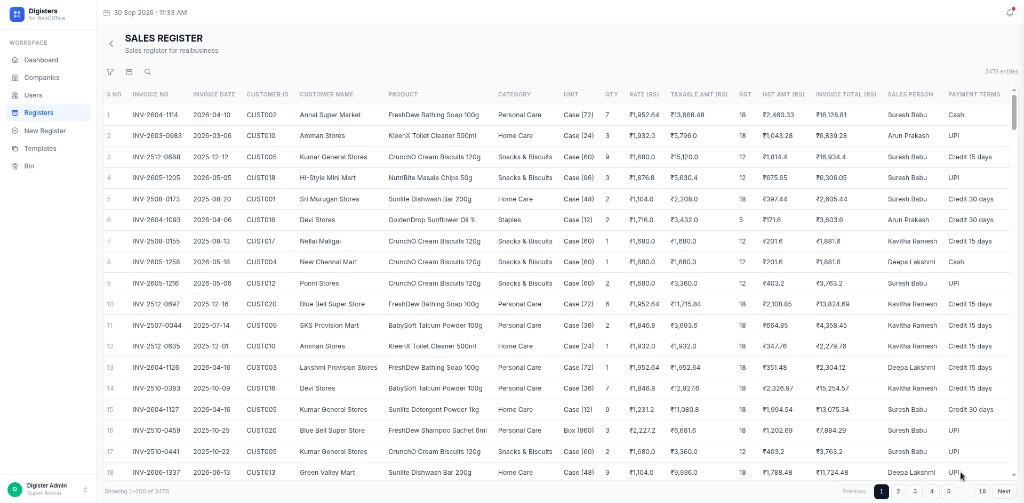
DIGISTERS: structured registers used by REALOFFICE
| Business need | System | How REALOFFICE uses it |
|---|---|---|
| Company Files | OpenCloud | A central place for business files and controlled team access. |
| Team Projects | Plane | Projects, work assignments, responsibilities and follow-up. |
| Client Relationships | Twenty CRM | Customer and relationship information kept in a structured system. |
| Client Digital Vault | Paperless-ngx | Client documents organised, searchable and available when required. |
| Internal Registers | DIGISTERS | Structured operational registers replacing recurring manual records and fragmented spreadsheets. |
Why open source?
Open source is not simply about getting software without paying licence fees.
For a small business, the bigger advantages can be practical.
More control over systems and data
Reduce unnecessary dependence on a single software vendor.
Ability to move and evolve
Choose systems that can change as the business changes.
Better cost discipline
Not every business requirement needs another recurring per-user subscription.
Choice
Use different systems for different requirements instead of forcing everything into one suite.
Long-term continuity
Build systems around accessible data, documentation and maintainable platforms.
Open where appropriate
Open source is not automatically the right answer to every requirement. OSWORKS recommends open-source systems where they make practical business sense.
But who will manage all this?
That is the reason OSWORKS exists.
A small business may not want to employ a Linux administrator, server engineer, implementation consultant, application specialist and separate employee trainer. Nor should it have to.
OSWORKS provides the layer between the software and the business.
You use the system. We help keep it usable.
- System configuration
- User setup and permissions
- Initial data organisation
- Implementation and user training
- Day-to-day questions
- New employee onboarding
- Updates and backups
- Basic monitoring
- Problem resolution
- Gradual improvement
You do not have to understand the technology
You may hear words such as Linux, Docker, servers, databases, APIs, backups and open source. You do not need to become an expert in any of them. The question that matters is: What should this system help my business do better? The technical responsibility remains with OSWORKS. Your role is to tell us how the business works and what needs improving.
What “Managed” means
Managed.
OSWORKS does not simply install software and leave. Somebody remains responsible for helping the system continue working.
- There is someone to call.
- Users can be helped when they get stuck.
- New employees can be brought into the system.
- Systems can be maintained and improved.
- Problems can be escalated to the right technical level.
Start where you need
We have a direction, but we do not force a sequence
Our preferred long-term direction is to help the business progressively digitise its important operational information. But the starting point depends on the business.
We begin where the client has the clearest need and gradually build from there.
OSWORKS working principle
Our direction is complete digitalisation of useful business data. Our starting point is wherever the client has the most practical need.
Supported systems
Open-source systems we currently work with
The business need comes first. These are some of the systems OSWORKS currently uses to meet those needs.
OSWORKS also works with selected open-source systems for forms, knowledge management, communication and business automation.
Who OSWORKS is for
Practical systems for real businesses.
OSWORKS is designed primarily for small and growing businesses that:
- do not want to build a full internal technology team;
- want practical systems rather than complicated technology projects;
- want greater control over their business information;
- are willing to gradually improve how work is organised;
- value having someone available to implement, train and support their team.
Professional Services
Consulting, legal, finance, design and other service businesses.
Trading and Distribution
Manage inventory, orders, suppliers and customers.
Project-Based Businesses
Plan work, track progress and keep information in one place.
Compliance-Focused Businesses
Keep documents, registers and statutory information organised.
Talk to us
Start with one problem.
You do not need to prepare a technology specification. You do not need to decide which software you want.
Just tell us:
What part of your business is difficult to manage today?
We will begin there.
Head – Technology & Implementation
phravin@osworks.in
+91 81223 39004
OSWORKS
A Unit of REALSME VENTURES PRIVATE LIMITED
Business Systems. Managed.